Entropy wave
Overview
A small-amplitude sinusoidal density perturbation propagates at 45° across a doubly-periodic box on a uniform background with no magnetic field. Because the perturbation is a pure entropy mode — there is no pressure perturbation and the magnetic field is zero — the wave simply advects with the background fluid velocity very similar to the 'advection' test. The analytic solution is known at all times making this a precise test of the code's ability to preserve linear wave structure over many crossing times. As with the advection test, this problem exercises only the hydrodynamic sector of the code.
Setup
The domain is the unit square \([0,1]\times[0,1]\) in Minkowski coordinates with periodic boundaries on all four sides. The background state is uniform with \(\rho_0 = 1\), \(u_0 = 0.01\), and a bulk 3-velocity of magnitude \(u_{10} = 0.1\) directed along the diagonal. The initial density perturbation is
where \(A = 0.01\), \(\delta\rho = 1\), and the wave-vector components are \(k_1 = k_2 = 2\pi\) (one full wavelength along each axis, giving a diagonal wavelength \(\lambda = 1/\sqrt{2}\)). The background 3-velocity components are
$$ \tilde{u}^x = \tilde{u}^y = u_{10}\rm{cos}(\pi/4),\qquad \tilde{u}^z = 0,\qquad \mathbf{B} = 0, $$ The analytic solution at time \(t\) is
$$ \rho(x,y,t) = \rho_0 + A\,\delta\rho\,\cos\bigl(k_1(x - v^x t) + k_2(y - v^y t)\bigr), $$ where \(\gamma = \sqrt{1 + u_{10}^2}\) is the Lorentz factor and \(v^i=\tilde{u}^i/\gamma\).
Parameters
Relevant compile-time parameters are:
| Parameter | Default | Notes |
|---|---|---|
N1TOT, N2TOT |
256 |
Grid resolution; change for convergence study |
METRIC |
MINKOWSKI |
|
RECONSTRUCTION |
LINEAR |
|
X{1,2}{L,R}_BOUND |
PERIODIC |
Output and convergence
The video below shows \(\rho\) over the run at the default \(256\times256\) resolution.
A plotting script for individual dumps is provided at prob/entropy_wave/plot_entropy_wave.py.
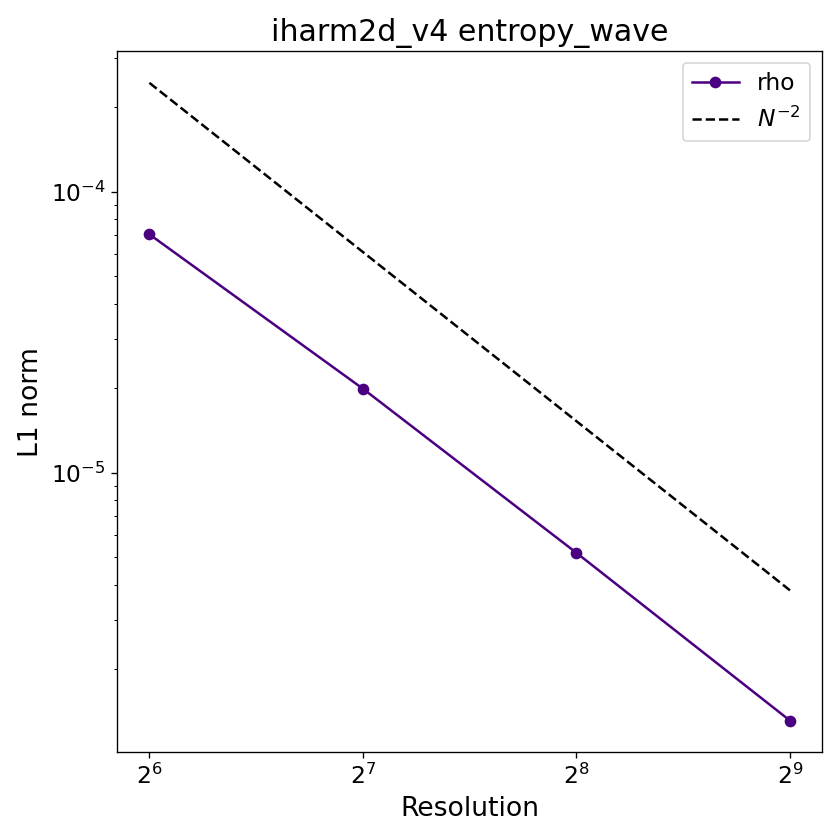
Because the analytic solution is known at all times, the L1 error at the final dump is
Below is the convergence plot with LINEAR reconstruction; the expected slope is \(L_1 \propto N^{-2}\).