Bondi accretion
Overview
Spherically symmetric, radial accretion onto a Schwarzschild black hole. The relativistic Bondi solution (Michel 1972, Hawley et al. 1984) provides an exact steady-state for density, internal energy, and radial velocity as functions of radius, fully determined by the mass accretion rate \(\dot{M}\) and the sonic radius \(r_s\). The code is initialized with this analytic solution and evolved forward in time; because the solution is stationary, any deviation at the final dump is purely numerical error. This test uses a curved spacetime and exercises the GR sector of the code.
Setup
The domain spans \([R_{\rm hor}, R_{\rm out}]\) radially and \([0, \pi]\) in polar angle, using Modified Kerr-Schild (MKS) coordinates with \(a = 0\) (Schwarzschild). The analytic solution is characterized by two conserved constants,
$$ C_4 = r^2T^{N/2}u^r, \qquad C_3 = \left[1 + \bigg(1 + \frac{N}{2}\bigg)T\right]^2!\left[1 - \frac{2}{r} + (u^r)^2\right], $$ where \(N = 2/(\Gamma-1)\) is the number of degrees of freedom, and \(T\) is the dimensionless temperature (\(\propto kT/mc^2\)). These are fixed by the sonic conditions at \(r = r_s\),
$$ u^r_s = \sqrt{\frac{1}{2r_s}}, \quad T_c = \frac{2N c_{s,c}^2}{(N+2)(2-Nc_{s,c}^2)}, \quad c_{s,c}=\frac{(u^r_c)^2}{1-3(u^r_c)^2}, $$ where \(c_{s,c}\) is the sound speed at \(r_s\). At each radius, \(T(r)\) is obtained by Newton-Raphson root-finding of \(C_3(r, T) - C_3 = 0\), then
where \(K = (4\pi C_4/\dot{m})^{1/n}\). The outer boundary applies the analytic solution at every timestep (X1R_BOUND USER); the inner boundary is outflow with no inflow enforced (X1L_BOUND OUTFLOW, X1L_INFLOW 0). There is no magnetic field.
Parameters
Problem-specific runtime parameters are:
| Parameter | Meaning |
|---|---|
mdot |
Mass accretion rate \(\dot{M}\) |
rs |
Sonic radius |
Rhor |
Inner radial boundary (set slightly outside \(r = 2M\)) |
Relevant compile-time parameters are:
| Parameter | Default | Notes |
|---|---|---|
N1TOT, N2TOT |
64 |
Grid resolution; change for convergence study |
METRIC |
MKS |
Modified Kerr-Schild |
RECONSTRUCTION |
WENO |
|
X1L_BOUND |
OUTFLOW |
Inner radial boundary |
X1R_BOUND |
USER |
Outer radial boundary — analytic Bondi solution |
X2L/R_BOUND |
POLAR |
|
X1L_INFLOW |
0 |
No inflow at inner boundary |
Convergence
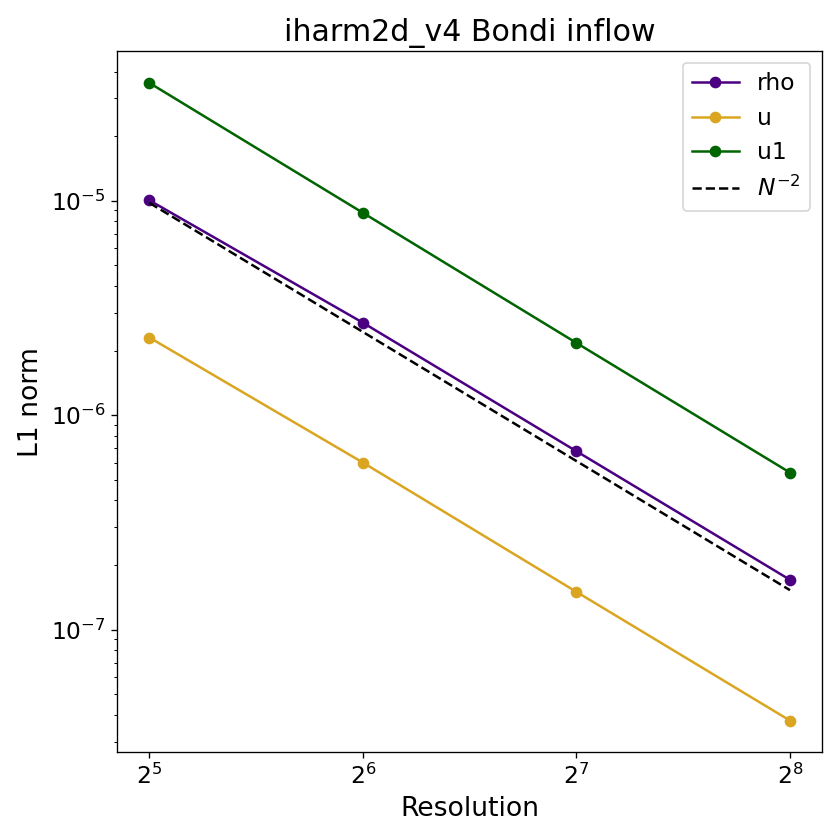
Because the solution is stationary, the L1 error is computed by comparing the final dump to the initial dump for \(\rho\), \(u\), and \(u^r\), excluding zones inside the event horizon,
The errors in \(\rho\), \(u\), and \(\tilde{u}^1\) exhibit the expected second-order convergence, \(L_1 \propto N^{-2}\).
References
- Michel (1972) — relativistic Bondi solution.
- Hawley et al. (1974) - relativistic Bondi solution formulated in terms of thermodynamic quantities at sonic point instead of asymptotic values.